
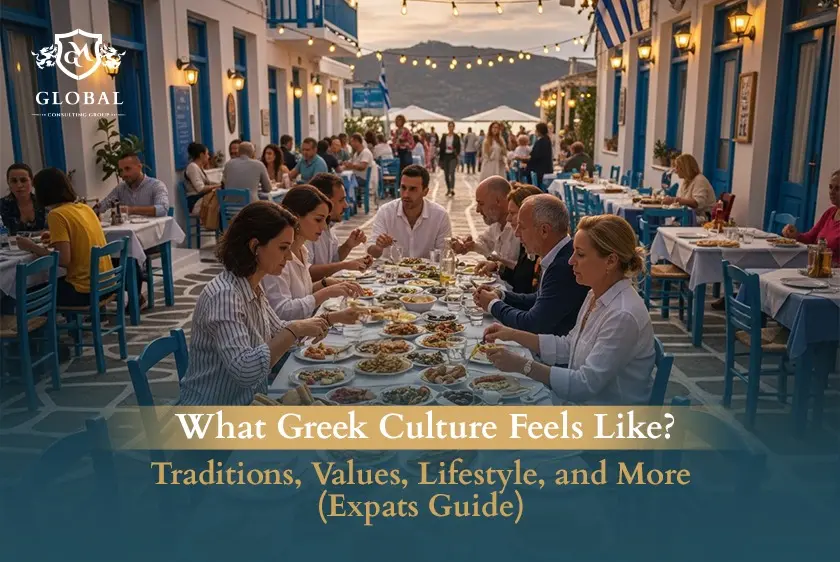
Greek culture feels warm, expressive, and deeply human, shaped by strong family bonds, heartfelt hospitality, and traditions that stretch back thousands of years. Family sits at the center of everyday life, often extending beyond the nuclear unit to include close relatives and lifelong friends. Hospitality (filoxenia) is not just a custom but a mindset; guests are welcomed generously, and socializing is a cherished part of daily living. Greeks value human connection, long conversations, shared meals, and time spent together, whether at a café, a family gathering, or a late-night walk. Life is meant to be enjoyed: going out, celebrating, laughing, and savoring the moment matter just as much as work. This outlook is reflected in a relaxed approach to time, where relationships often take priority over rigid schedules. Alongside this easygoing lifestyle is a strong sense of national pride and a deep emotional connection to history, mythology, and cultural heritage. Art, music, dance, and storytelling are woven into everyday life, keeping ancient influences alive in modern expression.
In this article, we’ll explore what Greek culture truly feels like from an insider and expat perspective. We’ll take a closer look at core values, daily lifestyle, social norms, traditions, and attitudes toward work and leisure, helping you understand what to expect when living in or interacting with Greece and why so many people fall in love with its way of life.
The Origins of Greek Culture
Greek culture today is the result of thousands of years of history layered one on top of the other, blending ancient ideas with religious tradition and Mediterranean influences. One of the strongest foundations comes from Ancient Greece (c. 800–146 BC), which shaped core values such as community life, public debate, hospitality, art, philosophy, and respect for knowledge. Concepts like democracy, theater, athletics, and mythology still influence modern Greek identity, storytelling, and national pride. Ancient myths, gods, and historical figures remain deeply embedded in language, festivals, education, and everyday references.
Another defining force is Greek Orthodox Christianity, which became central during the Byzantine era (c. 330–1453 AD) and continues to shape moral values, family life, and celebrations today. The Orthodox Church influences major holidays, naming traditions, fasting periods, and life events such as baptisms and weddings. It also reinforces values like generosity, close-knit communities, respect for elders, and the importance of ritual and tradition in daily life.
Finally, Greece’s position in the Mediterranean exposed it to Roman, Ottoman, Balkan, and broader Mediterranean influences, particularly during the Ottoman period (1453–1821) and after independence in the 19th century. These influences can be seen in cuisine, music, architecture, and social customs from shared dishes and coffee culture to relaxed social rhythms and expressive music and dance. Together, these historical layers shape modern Greek culture, creating a society that values tradition and faith while embracing social connection, celebration, and a distinctly Mediterranean approach to life.
Core Values of Greek Society
Greek society is built around values that emphasize connection, continuity, and belonging. These principles shape everyday behavior, social expectations, and the way people relate to one another, whether within the family, the neighborhood, or the wider community. Rooted in tradition and reinforced through religion, history, and shared experiences, these values help explain why relationships and social life play such a central role in Greek culture.
- Family loyalty and the extended family: Family is the cornerstone of Greek life, often extending well beyond parents and children to include grandparents, aunts, uncles, and cousins. Family members support one another emotionally, financially, and socially, and major decisions are frequently made with the family’s well-being in mind.
- Respect for elders and social hierarchy: Older generations are highly respected for their experience and wisdom. Elders often play an influential role in family matters, traditions, and childcare, and showing respect through language, behavior, and attentiveness is an important social norm.
- Strong community bonds and local society: Greeks place great value on their immediate community, whether it’s a village, neighborhood, or social circle. Local connections foster a sense of trust, mutual support, and shared identity, making everyday life more communal and socially interconnected.
Hospitality and Generosity in Greece: Philoxenia
Hospitality in Greece goes far beyond polite manners; it is deeply rooted in the concept of philoxenia, a word that literally means “love of the stranger.” This value dates back to Ancient Greece, where welcoming guests was considered a moral duty protected by the gods, and it remains a powerful cultural principle today. Philoxenia reflects the belief that guests should be treated with warmth, respect, and generosity, whether they are close friends, distant relatives, or complete strangers.
In practice, philoxenia shows up in many everyday interactions. Guests are warmly welcomed and often encouraged to eat more, stay longer, and feel completely at home. Offering food, drinks, or coffee is considered essential, even during brief visits. Compliments and friendly conversation help create an atmosphere of closeness and ease, while small gifts such as sweets, wine, or pastries are common when visiting someone’s home. Hosts take pride in caring for their guests, often going out of their way to ensure comfort and enjoyment, while guests are expected to show appreciation and respect. This mutual exchange of generosity reinforces strong social bonds and reflects the Greek belief that human connection is one of life’s greatest values.
Love of Life and Joy in Greece: The “Kefi” Attitude
Kefi is one of the most expressive words in Greek culture, capturing a deep sense of joy, passion, emotional energy, and love for life. It doesn’t translate neatly into English, but it describes a state of high spirits when people feel uplifted, connected, and fully present in the moment. Kefi is not just happiness; it’s a contagious enthusiasm that often emerges through music, laughter, dancing, and shared experiences.
This attitude is reflected in how Greeks approach life’s ups and downs. Even during difficult times, there is a strong tendency to find moments of joy, celebrate togetherness, and release emotions through social gatherings. Kefi often comes alive at weddings, festivals, family celebrations, late-night dinners, and spontaneous nights out where music plays and dancing begins. People may shout “Kefi!” to encourage the mood, praise a lively atmosphere, or express excitement when energy in the room peaks. Whether it’s clapping along to live music, breaking into dance, or simply enjoying long conversations with friends, kefi represents the Greek belief that life is meant to be felt deeply and enjoyed collectively.
Religion in Greece
Religion plays an important cultural and social role in Greece, even for those who may not consider themselves deeply religious. The dominant faith is Greek Orthodox Christianity, practiced by an overwhelming majority of the population. Approximately 90–93% of Greeks identify as Greek Orthodox. Smaller religious communities also exist, reflecting Greece’s historical and regional diversity.
- Greek Orthodox Christianity: 90–93%
- Muslims: 2–3% (mainly in Thrace and among immigrant communities)
- Roman Catholics: 1% (notably in the Cyclades and some urban areas)
- Other Christian denominations (Protestants, etc.): <1%
- Jewish community: <0.1%
- No religion / unaffiliated: 4–6%
Despite varying levels of personal observance, Greek Orthodoxy remains closely tied to national identity, traditions, public holidays, and everyday customs, influencing social values, celebrations, and major life events across Greek society.
In general, many Greeks are culturally religious rather than strictly observant. Regular church attendance varies, but religious customs, symbols, and holidays are widely respected and practiced. Churches are present in nearly every neighborhood and village, and major life events such as baptisms, weddings, and funerals are commonly held in the Orthodox tradition. Religious observance becomes especially visible during important periods like Easter, which is the most significant religious celebration in Greece, as well as Christmas and major saints’ feast days.
The practical influence of religion can be seen in church festivals (panigyria), local feast days, and community gatherings that combine worship with food, music, and celebration. Many Greeks celebrate name days (based on saints’ days) even more enthusiastically than birthdays. Religious teachings also encourage values such as generosity, charity, and care for those in need. Giving to poorer people, sharing food, and supporting community members during hard times are common expressions of faith, often organized through the church or practiced informally at the local level. Overall, religion in Greece functions as both a spiritual guide and a social glue, reinforcing traditions, community bonds, and shared moral values.
Other cutura believes in Greece
Alongside religion, Greek culture includes a rich layer of traditional beliefs and folk practices that many people acknowledge even if half-jokingly as part of everyday life. These beliefs are passed down through generations and often coexist naturally with modern thinking and religious faith.
One of the most common beliefs is the evil eye (mati), the idea that envy or excessive admiration can cause bad luck, illness, or misfortune. Many Greeks wear blue eye charms, keep them in their homes or cars, or perform special prayers or rituals to remove the evil eye, especially for children and babies. Compliments are often followed by phrases meant to “neutralize” envy.
Greeks also pay attention to lucky and unlucky gestures and symbols. Spitting lightly (or mimicking it by saying “ftou ftou ftou”) is a traditional way to ward off bad luck or jealousy. Certain actions, like stepping into a house with the right foot first or hanging a pomegranate at the door for New Year, are believed to bring good fortune. Conversely, breaking a mirror or wishing someone luck in the “wrong” way may be avoided.
Blessing rituals are another important cultural practice. Homes, businesses, boats, and even schools are often blessed by a priest, especially at the start of the year or before a new beginning. Holy water, icons, and candles are commonly used for protection and good health. While not everyone takes these beliefs literally, they remain an important part of Greek cultural identity, blending superstition, tradition, and faith into everyday life.
Social Life in Greece
Social life in Greece is lively, open, and deeply people-centered. Greeks place great importance on spending time with others, maintaining strong relationships, and creating a sense of belonging wherever they go. Daily life is shaped by frequent social interaction, whether through casual visits, long conversations, or spontaneous gatherings that often last late into the night.
Visiting culture is a key part of Greek social life. Friends and family regularly drop by one another’s homes, sometimes with little notice, and guests are almost always welcomed warmly. Hosting is informal, but a generous offering of coffee, sweets, or food is expected, no matter how short the visit. These gatherings are less about planning and more about connection, conversation, and shared time.
Greeks also have a strong love of communication. Talking is an art form, often animated, emotional, and expressive, with plenty of storytelling, humor, and debate. Conversations can easily start with strangers at cafés, shops, or public places, reflecting an openness and friendliness that makes newcomers feel included. Friendships are highly valued and often deep and long-lasting, built on loyalty, trust, and regular contact. Whether among close friends or newly met faces, social life in Greece revolves around warmth, inclusion, and the belief that life is richer when shared with others.
The Café Culture in Greece
Cafés are at the heart of social life in Greece and serve as much more than places to grab a quick drink. They are social hubs where people meet to talk, relax, observe daily life, and maintain connections. Sitting at a café can last for hours, often over a single coffee, with no pressure to leave; time spent socializing is valued more than efficiency.
Greek café culture reflects the country’s relaxed attitude toward time and its love of conversation. Friends gather to catch up, debate ideas, share news, or simply enjoy each other’s company. It’s also common to see people meeting colleagues, reading, or even working casually, all while engaging with those around them. Cafés are welcoming spaces where conversations with strangers can naturally begin, reinforcing a sense of community and openness. Whether in a busy city square or a quiet seaside village, cafés play a central role in everyday Greek life.
Nightlife in Greece
Nightlife is an essential and much-loved part of Greek culture, reflecting the country’s passion for socializing, music, and enjoying life together. Going out is seen as a way to connect, unwind, and celebrate, not just as an occasional activity but as a regular part of the lifestyle, especially in cities and coastal areas.
Evenings tend to start late in Greece. Dinners often begin around 9 or 10 p.m., while bars, cafés, and clubs don’t truly come alive until after 11 p.m. or even midnight. A typical night out may include meeting friends for drinks, moving on to a lively bar or music venue, and sometimes ending in the early hours of the morning. Live music, especially Greek genres like laïko and rebetiko, plays a big role, as do dancing, singing along, and spontaneous expressions of kefi. Whether it’s a casual seaside bar, a bustling city club, or a traditional music venue, Greek nightlife is about shared energy, long conversations, and making the most of the night together.
Food in Greek Culture and Traditional Greek Cuisine
Food holds a central place in Greek culture and represents far more than nourishment. It is a social ritual, a way of expressing love and hospitality, and a key part of bringing people together. Meals are meant to be shared, enjoyed slowly, and accompanied by conversation, laughter, and connection. Greek cuisine has been shaped by the country’s Mediterranean climate, local agriculture, centuries of trade, and historical influences from Ancient Greece, Byzantium, and the wider Mediterranean region. Olive oil, fresh vegetables, herbs, grains, seafood, and simple cooking techniques form the foundation of dishes that are both flavorful and deeply rooted in tradition. Key transitional Greek Cuisines are:
- Moussaka : A layered dish of eggplant, minced meat, and béchamel sauce, often served at family gatherings and special occasions
- Souvlaki: Grilled meat skewers or wraps, a popular everyday street food enjoyed across the country
- Gyro: Rotisserie-cooked meat served in pita with vegetables and sauces, commonly eaten during casual meals and nights out
- Spanakopita: Spinach and feta cheese pie wrapped in crispy filo pastry, common at home meals and celebrations
- Dolmades: Grape leaves stuffed with rice or minced meat, frequently served as part of shared meze plates
- Greek salad (Horiatiki):A classic mix of tomatoes, cucumbers, olives, and feta, highlighting fresh Mediterranean ingredients
- Feta cheese: A staple in Greek cuisine, used in salads, pies, and everyday meals
- Lamb dishes: Especially popular during religious festivals, particularly Easter, when lamb is traditionally roasted
- Tsoureki: Sweet braided bread prepared for Easter celebrations
- Kourabiedes and Melomakarona: Traditional cookies made during Christmas and festive periods
- Meze culture: A variety of small dishes shared among friends, reinforcing the social nature of eating in Greece
Hosting & Guest Etiquette in Greece
Food-related etiquette in Greece is closely tied to hospitality and generosity, and understanding these customs can help expats and foreigners feel more at ease in social settings. When invited to a Greek home, food is offered as a sign of care and respect, and refusing it outright may be seen as impolite. Guests are usually encouraged, sometimes insistently, to eat more, and accepting at least a small portion is appreciated.
It is customary to bring a small gift when visiting someone’s home, such as sweets, wine, pastries, or flowers. Meals are often served family-style, with shared dishes placed at the center of the table, emphasizing togetherness rather than individual portions. Waiting for the host to invite everyone to start eating is polite, though the atmosphere is generally relaxed rather than formal.
Hosts take pride in providing abundance, so plates are frequently refilled, and guests may hear phrases encouraging them to eat more. Complimenting the food is warmly received and considered good manners. Meals are unhurried and social, often lasting for hours, so rushing or leaving immediately after eating may seem abrupt. For foreigners, embracing this slower pace and the spirit of sharing helps build stronger connections and shows respect for Greek cultural values around food and hospitality.
Arts in Greek Culture
Art has always been a vital form of expression in Greek culture, woven naturally into daily life rather than confined to galleries or formal settings. From ancient times to the present, Greeks have used art to tell stories, express emotion, preserve history, and strengthen social bonds. This deep appreciation for creativity is visible both in everyday routines and during special occasions.
Music and dance play a central role in social and cultural life. Traditional dances are performed at weddings, festivals, religious celebrations, and local panigyria, often involving entire communities rather than trained performers. Music, whether traditional folk, rebetiko, or modern Greek pop, is a constant presence in cafés, homes, and nightlife venues, encouraging participation, singing along, and spontaneous dancing.
Theater and storytelling have ancient roots in Greece and remain culturally significant today. Outdoor theaters are still used for performances, especially during summer festivals, connecting modern audiences to classical traditions. Storytelling, poetry, and expressive conversation are also part of everyday communication, reflecting a culture that values emotion and narrative.
Visual arts and crafts appear in architecture, religious iconography, pottery, and handmade goods. Icons and mosaics are commonly found in churches and homes, while local artisans continue traditional crafts in villages and markets. Overall, art in Greece is not just a profession or hobby; it is a living practice, integrated into celebrations, social life, and the rhythm of everyday living.
Festivals, Events & Local Celebrations in Greece
Festivals and local celebrations are a vibrant expression of Greek culture, bringing together tradition, religion, music, food, and community spirit. One of the most important concepts behind these celebrations is the panigyri, a traditional village festival usually held in honor of a patron saint. Panigyria takes place throughout the year, especially in summer, and transforms towns and villages into lively gathering spaces filled with music, dancing, shared meals, and religious ceremonies. They are open, welcoming events where locals and visitors celebrate side by side, reinforcing strong community bonds.
Greek festivals are typically joyful, social, and long-lasting. A celebration often begins with a church service, followed by outdoor festivities featuring live traditional music, group dancing, communal tables, and local food and wine. Dancing is usually circular and inclusive, allowing everyone, regardless of age or skill, to participate. These events highlight core Greek values such as togetherness, hospitality, and the joy of shared experience.
Beyond local panigyria, Greece hosts several major national and cultural events. Easter is the most significant religious celebration, marked by candlelit processions, midnight church services, fireworks, and large family feasts. Carnival (Apokries), held before Lent, features parades, costumes, and street parties across the country. Independence Day (March 25) combines religious observance with national pride through parades and ceremonies. Summer also brings music, theater, and cultural festivals, especially in ancient open-air theaters, blending modern performances with historic settings. Together, these festivals and events reflect Greece’s deep respect for tradition, love of celebration, and strong sense of community.
Weddings in Greece
Weddings in Greece are deeply symbolic events that reflect the country’s strong values around family, tradition, faith, and community. Marriage is seen not just as a union between two individuals, but as the joining of families, often celebrated with great enthusiasm and collective participation.
Most traditional Greek weddings follow the Greek Orthodox ceremony, which is rich in ritual and meaning. Elements such as the crowning of the couple (stefana), the shared cup of wine, and the ceremonial walk around the altar symbolize unity, commitment, and shared life. These traditions highlight values of spiritual partnership, mutual respect, and continuity across generations.
Beyond the ceremony, Greek weddings are highly social and celebratory. Large gatherings, abundant food, music, and dancing are central, reflecting the importance of hospitality and communal joy. Family members especially parents and grandparents play an active role in both the planning and celebration, emphasizing respect for elders and family bonds. Overall, Greek weddings embody key cultural values: devotion to tradition, deep family connections, generosity, and the belief that life’s most important moments should be shared with the wider community.
Greek Baptisms
Baptism holds deep religious and cultural significance in Greece and is considered one of the most important milestones in a person’s life. Rooted in Greek Orthodox tradition, baptism is seen as the child’s official entry into both the Church and the wider community. It is not only a religious sacrament but also a social event that strengthens family ties and creates lasting spiritual bonds.
Greek baptisms are closely associated with the role of the godparent (nonos or nona), who is chosen with great care. Godparents take on a lifelong responsibility for the child’s spiritual guidance and often play an active role throughout their life. The baptism ceremony includes symbolic elements such as the immersion in holy water, anointing with oil, and the giving of a Christian name this name often becomes central to the child’s identity and is later celebrated through name days.
Baptisms are typically followed by a social gathering where family and friends celebrate together. Guests may give gifts such as gold jewelry, clothing, or religious items, while the godparent traditionally provides the baptismal clothing, candle, and oil. Like many Greek traditions, baptisms emphasize values of faith, community, generosity, and continuity, reinforcing the importance of shared rituals in Greek cultural life.
Holidays and Important Days in Greece
Holidays in Greece reflect a strong blend of religion, history, and national pride. These days are widely observed and often celebrated through family gatherings, church services, public events, and shared meals. While Greece recognizes many religious and national holidays, a few stand out for their cultural importance and emotional significance.
The most important holidays and key dates in Greece include:
- Easter (Pascha): The most significant holiday in Greece, marked by Holy Week services, the midnight Resurrection ceremony, and large family feasts on Easter Sunday
- Christmas (December 25): A major religious and family-focused holiday celebrated with church attendance, traditional meals, and time with loved ones
- Epiphany (January 6): Known for the Blessing of the Waters and cross-diving ceremonies, especially in coastal towns and cities
- Independence Day (March 25): Commemorates the start of the Greek War of Independence in 1821 with parades, church services, and national celebrations
- Ohi Day (October 28): Marks Greece’s refusal to surrender during World War II and is observed with patriotic parades and events
- Assumption of the Virgin Mary (August 15): One of the most important religious holidays, often celebrated with church services and local panigyria
- Carnival (Apokries): A lively pre-Lenten period featuring costumes, parades, and street celebrations
- Name Days (Saints’ Feast Days): Widely celebrated personal holidays tied to the Orthodox calendar, often more significant than birthdays for many Greeks
Easter (Pascha) is by far the most important holiday in Greece. It is celebrated with deep religious devotion and powerful traditions that span an entire week. Holy Week includes church services, fasting, and processions, culminating in the midnight Resurrection service on Holy Saturday, when people gather with candles and greet each other with “Christos Anesti” (Christ is Risen). Easter Sunday is marked by large family feasts, roasted lamb, music, and celebration, symbolizing renewal, togetherness, and joy.
Other major religious holidays include Christmas, which focuses on family, church attendance, and festive meals, and Epiphany (January 6), celebrated with the blessing of waters and cross-diving ceremonies in coastal areas. Many Greeks also celebrate name days, often with open-house gatherings, as they are linked to saints’ feast days.
National holidays play an equally important role. Independence Day (March 25) commemorates the start of the Greek War of Independence in 1821 and is celebrated with military and school parades, church services, and national pride. Ohi Day (October 28) marks Greece’s refusal to surrender to Axis forces in World War II and is observed through parades and patriotic events. Together, these holidays highlight Greece’s deep connection to faith, history, and collective identity.
Sports in Greek Culture
Sports hold a meaningful place in Greek culture, rooted in both ancient history and modern-day passion. As the birthplace of the Olympic Games, Greece has a long-standing association with athleticism, competition, and physical excellence. Today, sports continue to be an important way Greeks express pride, loyalty, and collective identity, especially through watching and supporting teams.
Football (soccer) is by far the most popular sport in Greece. It is widely followed, passionately debated, and deeply tied to club loyalty, with teams like Olympiacos, Panathinaikos, and AEK Athens inspiring strong emotional support. Many Greeks may not play football regularly themselves, but watching matches, discussing results, and supporting their teams is a major social activity, often centered around cafés and sports bars.
Basketball is another highly loved sport, especially since Greece’s international success and the global recognition of Greek players. Games attract enthusiastic audiences, and basketball enjoys both strong viewership and active participation, particularly among younger generations.
Other sports such as volleyball, athletics, and water sports are also popular, especially in coastal areas and during summer. While some Greeks are actively involved in sports and fitness, many engage primarily as passionate spectators, similar to sports culture in countries like Egypt. Overall, sports in Greece are less about routine participation for everyone and more about shared excitement, team loyalty, and social connection—bringing people together through collective emotion and national pride.
Language in Greek Culture
The Greek language is a major source of pride and identity in Greece, carrying a history that spans thousands of years. Modern Greek is directly connected to Ancient Greek, making the language a living link between past and present. This deep historical continuity gives the language strong cultural value, and many Greeks feel a close emotional attachment to it as a symbol of heritage, education, and national unity.
For expats, learning even basic Greek can make a significant difference in daily life and social integration. While many Greeks, especially in cities and tourist area,s speak English, making the effort to use simple Greek phrases is highly appreciated. It is seen as a sign of respect for the culture and often leads to warmer interactions, better service, and stronger personal connections. Greetings, polite expressions, and basic conversation go a long way in building trust and goodwill.
Language in Greece is also closely tied to communication style. Greeks tend to speak expressively, using tone, gestures, and emotion to convey meaning. Understanding a few words and cultural expressions helps expats better grasp social cues and participate more fully in conversations. Overall, learning Greek basics is not just practical; it’s a key step toward feeling included and truly experiencing Greek culture.
Architecture and Urban Design in Greece
Greek architecture reflects the country’s long history, varied geography, and layered cultural influences, blending ancient forms with Byzantine, Ottoman, and modern elements. One of the most iconic foundations is Ancient Greek architecture, known for its harmony, balance, and proportion. Classical temples, columns (Doric, Ionic, and Corinthian), open theaters, and public squares emphasized symmetry and connection to nature principles that continue to influence design and urban planning today.
Byzantine architecture left a strong mark on churches and monasteries, characterized by domes, arches, mosaics, and religious symbolism. These structures remain central features in towns and cities, reinforcing the close link between architecture, faith, and community life. During the Ottoman period, additional elements such as courtyards, fountains, and stone houses became common, especially in older neighborhoods and villages.
Modern Greek architecture often blends tradition with practicality. In cities, apartment buildings dominate, while in islands and rural areas, whitewashed houses, blue accents, flat roofs, and narrow streets reflect adaptation to climate and landscape. Local materials, outdoor living spaces, and close-knit layouts emphasize community interaction and a relaxed Mediterranean lifestyle. Overall, Greek architecture tells the story of a culture that values history, functionality, beauty, and a strong sense of place.
Cultural Tips and Advice for Expats Traveling to Greece
If you are looking to relocate to Greece, plan an extended stay, or even visit with the intention of understanding daily life beyond tourism, learning a few cultural basics can make your experience far smoother and more rewarding. Greek culture is welcoming and relaxed, but it is also deeply rooted in tradition, relationships, and unspoken social norms. Being aware of these customs helps expats integrate more easily, avoid misunderstandings, and build genuine connections with locals.
- Embrace a slower pace of life: Be flexible with time, especially in social settings, as relationships often take priority over strict schedules.
- Learn basic Greek phrases: Even simple greetings and polite expressions are highly appreciated and show respect for the culture.
- Accept hospitality openly: Whether it’s a coffee, food, or an invitation, generosity is sincere and meant as a warm gesture, not an obligation.
- Respect religious and cultural traditions: Dress modestly when visiting churches and be mindful during religious or national holidays.
- Value personal connections over formality: Building trust and relationships matters more than rigid etiquette or official procedures.
- Approach with openness and curiosity: A positive attitude, patience, and genuine interest in local customs will greatly enrich your experience in Greece.
Final Thoughts
Greek culture is not just something you observe, it’s something you live. From strong family values and warm hospitality to a relaxed lifestyle, rich traditions, and deep respect for history, Greece offers a way of life centered on human connection and enjoyment. For expats, this balance of community, culture, and quality of life makes Greece an especially attractive place to call home, not just to visit.
If you’re considering taking the next step, whether through citizenship or residency options, Greece offers unique opportunities to build a future in one of Europe’s most culturally rich and welcoming countries. With the right guidance, navigating residency programs, long-term relocation, or citizenship pathways can be smooth and rewarding.
Global for Citizenship and Residency is here to help you turn that vision into reality. Our experts support you at every stage, from understanding your eligibility to securing the pathway that best fits your goals. Reach out today to explore your options and start your journey toward living, investing, or settling in Greece with confidence.