
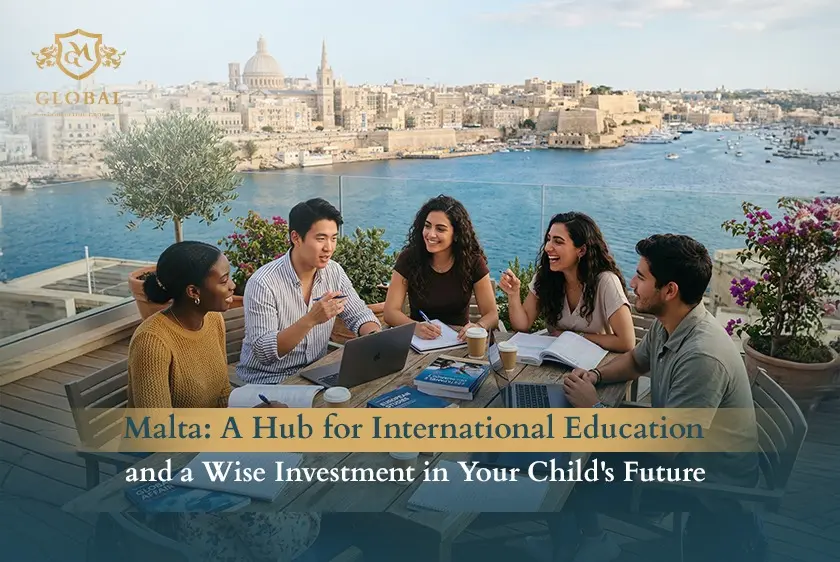
Malta offers a high-quality, internationally recognized education system, making it an excellent choice for families seeking both residency and a strong academic future for their children. As an EU member state, Malta combines European educational standards, English-language instruction, and a safe, family-friendly environment, making it especially attractive for expatriate families relocating from the Middle East, Africa, and beyond.
The Maltese Education System
The Maltese education system is largely based on the British model and is structured into several stages. Children typically begin with Early Childhood Education (Kindergarten) from ages 3 to 5, followed by Primary Education for 6 years (ages 5 to 11). Secondary education (ages 11 to 16) is divided into two sub-stages: Middle School (ages 11 to 13), designed to ease the transition from primary with a more individualized learning environment, and Secondary School (ages 13 to 16). After secondary, students may pursue Post-Secondary or sixth-form education (2 years) or vocational training, before proceeding to Higher Education, with bachelor’s degrees typically lasting 3 to 4 years and followed by postgraduate studies.
Malta’s curriculum follows European standards with strong British influence. Students are assessed through a combination of continuous evaluation and national examinations, including O-Level and A-Level equivalents. Schools in Malta operate across three sectors: state schools (59.6% of registrations), church schools (26.7%), and independent/private schools (13.7%), with total compulsory education enrolments reaching 60,197 students in the 2023 to 2024 academic year.
One of Malta’s greatest advantages is that English is an official language and the primary medium of instruction, alongside Maltese, making integration seamless for international students and families from day one.
Malta as a Global Education Hub
Malta has rapidly positioned itself as a growing international education destination, supported by a significant rise in foreign residents and international students. As of 2023, foreign nationals make up over 28% of Malta’s population, reflecting sharp growth in migration and residency demand.
This trend is clearly reflected in education statistics published by Malta’s National Statistics Office (NSO):
- At the post-secondary level, international students represent 17.4% of total enrolments (1,808 students) in 2023/24.
- At the tertiary level, international students now account for 37% of all university enrolments, a 27% year-on-year increase, with 8,252 foreign students enrolled in 2023/24.
- Indian students saw the largest single-year jump at the tertiary level, rising by 130.2% year-on-year, followed by Nigerian (97.3%) and French (48.9%) students.
This growing international demand signals Malta’s evolution into a genuine global education hub. The key factors driving this reputation include:
- High-quality education aligned with European standards: Malta follows the European Qualifications Framework (EQF), ensuring degrees and certifications are internationally recognized and transferable across EU member states.
- English is the primary language of education, widely spoken by over 88% of the population, removing language barriers for international families.
- Diverse schooling options, with families able to choose between state, church, and private/international institutions, offering flexibility in curriculum, teaching style, and budget.
- A safe and family-friendly environment, with Malta recognized for its low crime rates and stable society, making it an ideal destination for families relocating with children.
- Affordable education compared to other EU countries, with public schooling free for residents and private and university costs significantly lower than in the UK or the US.
- A growing multicultural community, with rising international enrolments at all levels, offering genuine global exposure within a small, accessible country.
What Makes Malta’s Education Stand Out
Malta’s education system distinguishes itself through a combination of academic rigor, international recognition, and practical accessibility for expat families. Unlike many EU countries where language barriers limit integration, Malta’s English-language system allows children to enroll and thrive immediately, without needing to learn a new language first.
Key advantages include:
- British-influenced, EU-aligned curriculum with qualifications recognized across Europe and internationally, equivalent to O-Levels, A-Levels, and accredited university degrees.
- Strong accreditation and quality standards, with all schools and universities regulated and accredited by national authorities, including the Malta Further and Higher Education Authority (MFHEA).
- Wide range of international schools, including institutions offering the International Baccalaureate (IB) and British curriculum, specifically designed for expat families.
- Balanced academic and personal development, with the system integrating extracurricular activities, critical thinking, and practical skills alongside academic achievement.
- Flexibility for different budgets, with free public education for residents and private options that remain competitively priced compared to Western Europe.
Top International Schools in Malta
Malta is home to several well-established international schools catering specifically to expat families, offering globally recognized curricula, modern facilities, and English-language instruction.
- Verdala International School offers the International Baccalaureate (IB) programme from early years through to diploma level. It features modern campuses, science labs, sports facilities, and a diverse student body. Annual fees range from approximately EUR 10,000 to EUR 15,000.
- QSI International School of Malta follows the US College Board’s Advanced Placement (AP) programme, with international accreditation, small class sizes, and strong individualized academic support. Annual fees range from approximately EUR 8,000 to EUR 12,000 depending on grade level.
- Chiswick House School and St. Martin’s College are partner schools following the British curriculum, guiding students from early years through secondary education. They are known for structured academics, strong exam performance, and modern learning facilities.
- San Andrea School is a well-regarded independent school offering a holistic education approach, combining academics with extracurricular activities including sports, arts, and leadership development.
- St. Edward’s College is modeled on the traditional British public school system, offering both day and boarding options, with strong academic standards and a focus on character development. Annual fees for day students range from approximately EUR 7,000 to EUR 10,000.
- Haileybury Malta is a premium international school with annual tuition ranging from EUR 11,445 (Reception) up to EUR 19,158 (Years 9 to 11), making it one of Malta’s most comprehensive British-curriculum institutions for families seeking a top-tier experience.
Top Universities in Malta
Malta’s higher education sector offers internationally recognized degrees, English-language instruction, and EU-aligned qualifications at costs significantly lower than comparable UK or US institutions.
- University of Malta (UoM) is the country’s leading public university, established in 1592, offering a wide range of undergraduate and postgraduate programmes. It is highly respected across Europe, with strong faculties in medicine, engineering, business, and law. Education is free for Maltese and EU students, while non-EU students pay tuition fees.
- Malta College of Arts, Science and Technology (MCAST) is Malta’s main vocational and higher education institution, offering practical, career-oriented programmes with a strong focus on technical education, applied sciences, and industry-relevant skills.
- American University of Malta (AUM) is a private institution offering an American-style education with globally recognized degrees, focusing on business, engineering, and technology with an emphasis on innovation and entrepreneurship.
- Global College Malta is a higher education institution specializing in business and management programmes, often delivered in collaboration with international universities, attracting a diverse global student body.
- Queen Mary University of London – Malta Campus is a branch of the UK-based university offering medical programmes with degrees awarded by Queen Mary University of London, providing an internationally recognized British qualification within a Malta-based setting.
Cost of Education in Malta for Expats
Malta’s education costs are moderate and flexible across all levels, offering options from fully free public schooling to premium international programmes.
| Level | School Type | Annual Cost |
| Primary and Secondary | State (public) schools | Free for residents |
| Primary and Secondary | Church schools | Small annual donation |
| Primary and Secondary | Local private schools | EUR 3,000 to EUR 6,000 |
| Primary and Secondary | Premium international schools | EUR 8,000 to EUR 19,000+ |
| University | University of Malta (Maltese/EU students) | Free |
| University | University of Malta (non-EU students) | EUR 8,000 to EUR 20,000 per year |
| University | Private universities | EUR 5,000 to EUR 25,000+ per year |
For most expat families, a realistic total annual budget per child at a local private school, including tuition, uniform, transport, meals, and extracurriculars, is approximately EUR 6,500 to EUR 8,500. Premium international schools such as Verdala or Haileybury Malta represent a higher investment but provide IB or British-curriculum qualifications directly aligned with top global universities.
Overall, Malta remains significantly more cost-effective than equivalent education in the UK, Switzerland, or the US, while maintaining high academic standards and international recognition.
Malta Permanent Residency: An Investment in Your Child’s Future
Obtaining Malta Permanent Residency is not just about securing the right to live in an EU country. It is a long-term investment in your child’s education, stability, and future opportunities. By establishing residency in Malta, families unlock access to a high-quality, English-language education system within the EU, with the freedom to live, study, and grow without visa interruptions or uncertainty.
For families with children from early school age through university, here is what residency in Malta makes possible:
- Access to EU university pathways, with children educated in Malta benefiting from EU-standard qualifications, making university admissions across Europe significantly smoother compared to applying from outside the EU.
- International exposure and a global mindset, with children growing up in a multicultural environment alongside students from dozens of nationalities, build communication skills, adaptability, and a global perspective from an early age.
- Globally recognized qualifications, from O-Level equivalents through to university degrees, are accepted by institutions and employers worldwide.
- Long-term stability, with permanent residency ensuring children can complete their full education without visa disruptions, and families can plan with genuine long-term confidence.
- Flexibility in schooling, with residents able to enroll children in state, church, private, or international schools, giving parents full freedom to choose the best fit for their child’s needs and family budget.
- Career advantages, with an EU-based education opening doors across European and international job markets, and graduates benefiting from broader employment options and recognized credentials.
Start Your Family’s Journey with Global for Citizenship and Residency
Choosing Malta as a destination for your family is more than a lifestyle decision. It is a strategic investment in your child’s education, opportunities, and future. With a high-quality, English-language education system, internationally recognized qualifications, and access to the full scope of European opportunities, Malta provides a strong and stable foundation for academic and professional success at every level.
Global for Citizenship and Residency is a licensed agent for the Malta Permanent Residency Programme (MPRP), offering professional, end-to-end support to help your family secure residency smoothly and efficiently. Our multilingual advisory team, including Arabic-speaking consultants, guides you through every step, from initial eligibility assessment and investment structuring to full application management and post-approval support.
Contact Global for Citizenship and Residency today to explore your residency options and take the first step toward securing a brighter, more stable future for your family in Malta.
All statistics sourced from Malta's National Statistics Office (NSO), Eurydice/European Commission, and the EU Education and Training Monitor 2025.