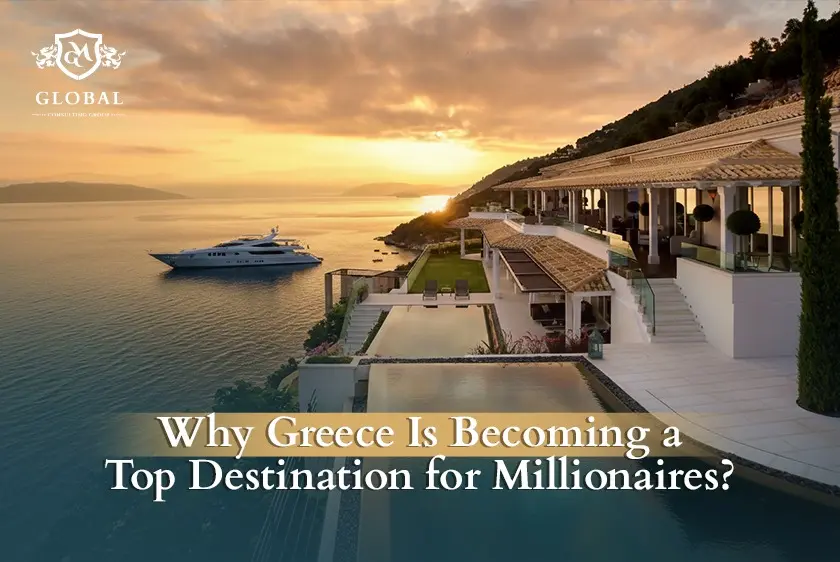
Millionaires in Greece are increasingly attracting international attention as the country strengthens its position as a Mediterranean destination for wealthy investors, entrepreneurs, and high-net-worth individuals (HNWIs). Combining an appealing lifestyle with investment opportunities, alternative tax regimes, and European residence options, Greece offers advantages for individuals seeking to diversify their international interests.
According to the Henley Private Wealth Migration Report 2025, Greece was forecast to receive a net inflow of approximately 1,200 relocating millionaires in 2025, placing it among the world’s leading destinations for wealthy migrants. The same report estimated that Greece’s millionaire population had grown by approximately 24% between 2014 and 2024.
Several factors contribute to this appeal, including Greece’s €100,000 annual non-dom tax regime for qualifying investors, its Golden Visa residence-by-investment programme, a growing luxury property market, and access to the wider European business environment.
From prestigious neighbourhoods in Athens to waterfront villas in Mykonos, Crete, and the Peloponnese, Greece offers different lifestyles for wealthy families seeking privacy, financial flexibility, and long-term residence.
This article examines how many millionaires live in Greece, why wealthy individuals relocate there, the country’s tax advantages, luxury residential destinations, wealth management opportunities, and the steps involved in obtaining Greek residency.
How many millionaires are there in Greece?
Greece has a substantial and growing population of high-net-worth individuals, although estimates differ depending on how wealth is measured.
An often-cited estimate places the country’s millionaire population at approximately 64,700 individuals in 2025. However, this figure should be treated as an indicative historical estimate rather than a verified official count for 2026.
Wealth reports may define millionaires as individuals with at least US$1 million in liquid investable assets, rather than those whose total net worth, including their primary residence, exceeds US$1 million. This distinction can significantly affect population estimates.
The country’s attractiveness is also reflected in international wealth migration research.
According to Henley & Partners’ 2025 report:
- Greece was projected to attract a net inflow of 1,200 millionaires during 2025.
- The estimated investable wealth associated with these incoming millionaires was US$7.7 billion.
- Greece ranked eighth among the destinations listed for projected millionaire inflows.
- Its millionaire population growth over the preceding decade was estimated at 24%.
These figures are migration estimates and projections, not a confirmed census of wealthy residents.
Greece’s affluent population includes shipping entrepreneurs, property investors, business owners, financial professionals, technology founders, and families with inherited wealth.
The concentration of wealth is particularly visible in Athens, Attica’s coastal suburbs, Mykonos, Crete, and selected luxury destinations across the Greek islands and mainland.
Why Are Millionaires Moving to Greece?
Millionaires are attracted to Greece by a combination of financial considerations, international mobility, investment opportunities, and quality of life.
For wealthy individuals relocating from countries with changing tax policies or higher living costs, Greece offers an alternative European base with distinctive advantages.
One of the most important attractions is the availability of special tax regimes for qualifying individuals who transfer their tax residence to Greece.
Under the investor non-dom regime, eligible taxpayers may pay a fixed annual amount on foreign-source income, subject to investment and other legal conditions.
The Greece Golden Visa programme provides another incentive by offering qualifying non-EU investors a renewable residence permit without a general minimum annual stay requirement.
Other factors encouraging millionaire relocation include:
- Lifestyle: Mediterranean weather, coastal living, international restaurants, cultural experiences, and leisure opportunities.
- Luxury property: Access to premium villas, waterfront residences, and exclusive residential developments.
- European positioning: A location within the EU and Schengen Area, supporting business connections and international travel.
- Investment diversification: Opportunities in hospitality, tourism, property development, renewable energy, shipping, and technology.
- Family considerations: International schools, private healthcare, and different residential environments.
- Long-term planning: Opportunities to establish a European residence base while maintaining business interests internationally.
Changes in tax policy, geopolitical uncertainty, and international mobility preferences can also influence relocation decisions.
However, the reasons wealthy individuals leave their home countries vary considerably, and Greece is not automatically the most tax-efficient or suitable destination for every investor.
What Do Millionaires Do in Greece?
Wealthy individuals in Greece participate in several important sectors of the economy, ranging from traditional industries to emerging investment opportunities.
Shipping and maritime businesses remain particularly significant. Greece has a globally influential shipping industry, with major business families involved in commercial vessels, maritime logistics, and international trade.
Real estate investment is another major activity. Wealthy investors purchase residential property, develop hospitality projects, and acquire commercial assets in locations with strong economic or tourism demand.
The tourism and hospitality sector offers opportunities involving luxury hotels, boutique resorts, holiday accommodation, marinas, and leisure services.
Other areas attracting affluent investors include:
- Renewable energy and infrastructure
- Technology companies and start-ups
- Private equity and venture capital
- International trade and logistics
- Financial investments and securities
- Agricultural businesses and premium food production
Not all millionaires relocate to Greece to establish businesses.
Some maintain international portfolios while residing in Greece, others retire there, and some divide their time between multiple countries.
Their activities depend on their residence status, tax position, business interests, and personal objectives.
How Greece Encourages Millionaire Migration?
Greece has introduced policies intended to attract international capital, encourage investment, and strengthen its position as a destination for internationally mobile individuals.
These measures include special tax regimes, investor residence permits, investment incentives, and initiatives supporting business development.
The country’s attractiveness is also supported by its membership in the European Union and the eurozone.
Nevertheless, tax residence, immigration residence, and investment eligibility remain separate legal matters. Approval under one framework does not automatically establish eligibility under another.
Key Factors That Encourage Millionaire Migration
- Alternative taxation for foreign investors
Qualifying individuals transferring their tax residence to Greece may apply for the non-dom regime, which provides a fixed annual tax on foreign-source income.
- Golden Visa residence programme
The Greek Golden Visa offers eligible non-EU investors a five-year renewable residence permit through qualifying investments, including certain real estate transactions.
- Tax incentives for foreign pensioners
Eligible foreign pension recipients who transfer their tax residence may qualify for a special 7% tax rate on foreign-source income for up to 15 tax years.
- Family office structures
Greece has introduced frameworks supporting family offices and the management of family wealth, subject to applicable operating and tax requirements.
- Investment opportunities
Luxury real estate, tourism infrastructure, shipping, energy, and technology provide opportunities for investors seeking exposure to the Greek economy.
- European location
Greece provides access to European markets and international transport connections, particularly through Athens and major regional hubs.
- Quality of life
Coastal property, cultural attractions, Mediterranean cuisine, and private lifestyle services contribute to Greece’s appeal among affluent residents.
Together, these factors create a compelling proposition for certain investors, particularly those who can combine appropriate tax planning with a suitable long-term residence strategy.
Greece’s Tax Regime for Millionaires and High-Net-Worth Individuals (HNWIs)
Greece’s tax system includes special provisions designed to attract foreign investors, pensioners, and professionals.
These regimes can offer significant advantages, but their availability depends on specific eligibility requirements.
Importantly, holding a Golden Visa does not automatically grant preferential tax treatment.
Individuals must assess their tax residence, sources of income, investment obligations, reporting requirements, and relevant international tax treaties.
1. Flat Tax Regime for Foreign Investors
Greece’s non-dom tax regime, established under Article 5A of its Income Tax Code, allows qualifying individuals transferring their tax residence to Greece to pay a fixed annual tax of €100,000 on foreign-source income.
The regime can apply for up to 15 tax years.
Eligible family members may be included for an additional €20,000 per person annually.
The principal eligibility conditions generally include:
- The applicant must not have been a Greek tax resident during seven of the eight years preceding the transfer.
- A qualifying investment of at least €500,000 must generally be made in Greece.
- The investment may involve eligible real estate, companies, securities, or other permitted assets.
- The investment must generally be completed within three years of applying.
- Specific exceptions to the investment condition may apply to holders of qualifying investor residence permits.
The €100,000 amount is an annual tax payment, not a one-time application fee.
Greek-source income remains subject to the ordinary applicable tax rules.
The regime may also provide exemptions from Greek inheritance and gift taxation concerning qualifying assets situated abroad.
For individuals with substantial foreign-source income, the arrangement can offer greater predictability in annual taxation.
However, its actual financial benefit depends on the applicant’s circumstances and tax obligations in other jurisdictions.
2. Tax Incentives for Foreign Pensioners
Greece offers a separate preferential tax regime for qualifying recipients of foreign pensions who transfer their tax residence to the country.
Under Article 5B, eligible individuals may pay a flat 7% tax on qualifying foreign-source income for up to 15 tax years.
Applicants generally must satisfy conditions relating to previous Greek tax residence and the country from which they transfer their tax residence.
The regime may appeal to wealthy retirees receiving pensions, dividends, investment income, or other foreign-source earnings.
However, eligibility, treaty treatment, and the classification of different income sources must be reviewed carefully.
3. Tax Relief for Skilled Professionals and Entrepreneurs
Greece also offers a special regime under Article 5C for certain individuals transferring their tax residence to take up qualifying employment or business activities.
Eligible applicants may receive a 50% exemption from Greek income tax on qualifying employment or business income for seven tax years.
The relief is subject to conditions concerning previous tax residence, employment or business activity, and the required period of residence.
For internationally mobile entrepreneurs and senior professionals, this may offer an alternative to the investor-focused non-dom regime.
However, it is not a universal tax exemption available to all foreign business owners.
4. Real Estate and Investment Benefits
Real estate remains an important consideration for wealthy individuals moving to Greece.
Luxury property ownership can provide residential accommodation, lifestyle advantages, and potential long-term investment exposure.
However, purchasing Greek property involves several taxes and expenses.
These may include:
- Property transfer tax or VAT, depending on the transaction and applicable rules.
- Notary, legal, registration, and due diligence expenses.
- Annual property ownership taxes, including ENFIA where applicable.
- Tax obligations relating to rental income.
- Potential taxes on future property disposals, depending on the rules in force.
Golden Visa holders are not automatically exempt from annual Greek property taxes.
Investors should also consider restrictions on short-term rental use for properties acquired under relevant Golden Visa provisions.
Property ownership should therefore be assessed independently of the immigration benefits associated with a qualifying investment.
5. Inheritance and Gift Taxes
Inheritance and gift taxation is an important component of wealth and succession planning.
Greece applies different tax rules depending on the relationship between the parties, the type of asset, and other relevant circumstances.
Transfers between close family members may benefit from more favourable thresholds or rates than transfers to unrelated individuals.
For example, qualifying gifts and parental transfers between certain close relatives may benefit from substantial tax-free allowances, subject to the applicable requirements.
Individuals approved under the investor non-dom regime may also benefit from special treatment concerning inheritance or gifts of assets located outside Greece.
However, this does not mean that all inheritance and gift transfers are automatically exempt from taxation.
Wealthy families should seek professional advice before transferring significant assets or restructuring international estates.
Is Greece a Good Place for Millionaires to Enjoy a Luxurious Lifestyle?
Yes. Greece offers an attractive lifestyle for millionaires who value coastal living, privacy, cultural experiences, and access to premium services.
Its luxury appeal is not limited to well-known tourist islands.
Athens provides cosmopolitan amenities, including upscale shopping, private healthcare, international schools, luxury residences, and sophisticated dining.
The Athenian Riviera offers a different experience, combining waterfront homes, beach clubs, marinas, and convenient access to the capital.
Meanwhile, destinations such as Mykonos, Santorini, Crete, and Porto Heli offer opportunities for private villas, exclusive hospitality, and yachting.
The main attractions include:
- Luxury accommodation: Seafront villas, contemporary residences, private estates, and serviced properties.
- Fine dining: International restaurants, acclaimed Greek cuisine, and premium hospitality experiences.
- Privacy: Secluded properties and destinations suited to discreet family living.
- Mediterranean leisure: Sailing, swimming, coastal dining, and outdoor activities.
- Cultural experiences: Museums, archaeological sites, festivals, and historic destinations.
- Family services: Private healthcare, international education, and specialist professional services.
Luxury living in Greece can be comparatively attractive, but prestigious properties in prime locations may command prices comparable to other established Mediterranean destinations.
Superyacht Marinas, Private Aviation & VIP Infrastructure
Greece’s coastline and island geography make it particularly appealing to yacht owners and international travellers.
The country offers several important marina destinations, including:
Flisvos Marina, Athens: A prominent marina serving large yachts and offering convenient access to Athens and the Athenian Riviera.
Astir Marina, Vouliagmeni: A luxury marina destination associated with the premium residential and hospitality environment of Vouliagmeni.
Gouvia Marina, Corfu: An established yachting centre serving the Ionian Islands.
Marina Zeas, Piraeus: A marina serving recreational vessels and larger yachts near central Athens.
Porto Heli: A prestigious coastal destination offering access to yachting facilities and nearby island destinations.
Private aviation services are also available through major airports and specialist operators, with Athens International Airport serving as a key international gateway.
However, private aviation availability, airport operating conditions, and seasonal restrictions vary by destination.
For ultra-high-net-worth individuals, access to yacht management, concierge services, private transport, security, and specialist property management can support a more convenient lifestyle.
Where Do Millionaires Live in Greece?
Wealthy residents and international investors are drawn to several locations across Greece.
Their choices depend on whether they prioritise business connectivity, privacy, coastal living, international schools, or exclusive leisure facilities.
1. Athens
Athens is one of Greece’s principal centres of wealth, business, and luxury residential property.
Affluent residents are particularly attracted to neighbourhoods such as Kolonaki, Psychiko, and Filothei.
Kolonaki offers luxury apartments, designer boutiques, galleries, restaurants, and a prestigious central location.
Psychiko and Filothei provide quieter residential environments with substantial homes, greenery, and proximity to international schools.
The nearby Athenian Riviera adds another dimension to luxury living.
Areas such as Glyfada, Vouliagmeni, and Varkiza offer waterfront residences, marinas, premium restaurants, and beach facilities.
Athens is particularly suitable for wealthy families and entrepreneurs seeking year-round services, business opportunities, and international transport connections.
2. Mykonos
Mykonos is internationally recognised for its luxury hospitality, nightlife, and premium holiday properties.
The island attracts affluent visitors, international investors, and owners of second homes.
Exclusive residential areas include Aleomandra, Agios Lazaros, and Ornos.
Luxury properties may feature panoramic sea views, swimming pools, private outdoor spaces, and convenient access to premium beaches and restaurants.
Mykonos is especially attractive to individuals seeking an energetic summer lifestyle.
However, high property prices, seasonal congestion, and tourism-related costs can make year-round residence less practical for some families.
3. Santorini/ The Picture-Perfect Hideaway
Santorini offers one of Greece’s most distinctive luxury environments.
The island is known for its volcanic landscape, whitewashed architecture, and dramatic views over the caldera.
Oia and Imerovigli are particularly associated with premium hospitality and luxury residences.
Wealthy property buyers may be attracted to boutique villas, historic buildings, and exclusive accommodation.
However, Santorini also presents investment challenges.
Land availability is limited, development is subject to planning restrictions, and tourism activity can create significant seasonal pressure.
Investors should carefully assess property legality, permitted uses, maintenance requirements, and long-term operating costs.
4. Crete
Crete offers an appealing balance between luxury, privacy, and practical year-round living.
As Greece’s largest island, it provides substantial infrastructure, healthcare facilities, educational options, and diverse residential locations.
Elounda is particularly associated with luxury resorts and waterfront villas overlooking Mirabello Bay.
Other attractive areas include Chania and selected coastal communities near Heraklion.
Crete can be suitable for wealthy families seeking a permanent residence rather than exclusively a seasonal holiday property.
Its size, varied landscapes, and established communities offer greater residential diversity than some smaller islands.
5. Thessaloniki
Thessaloniki is Greece’s second-largest city and an important commercial and cultural centre.
It appeals to wealthy residents seeking a sophisticated urban lifestyle outside Athens.
Prestigious residential areas include Panorama and Pylaia, where buyers can find spacious homes and properties with attractive views.
The city offers universities, private healthcare, cultural attractions, shopping, and a strong culinary scene.
Thessaloniki may also appeal to entrepreneurs with business interests in northern Greece and the wider Balkan region.
6. The Peloponnese – Discreet Luxury by the Sea
The Peloponnese is increasingly associated with discreet luxury, premium coastal property, and exclusive hospitality.
Two particularly notable destinations are Porto Heli and Costa Navarino.
Porto Heli attracts wealthy property owners seeking privacy, waterfront villas, and access to nearby islands.
Costa Navarino, in Messinia, is known for luxury resorts, golf facilities, premium residences, and high-end hospitality.
The region offers a quieter alternative to internationally famous island destinations.
For wealthy families seeking larger properties, coastal scenery, and a less seasonal residential environment, parts of the Peloponnese may be particularly appealing.
Wealth Management, Banking & Asset Protection in Greece
For high-net-worth individuals, relocating to Greece involves more than purchasing property or obtaining a residence permit.
Effective wealth management requires careful coordination of banking, taxation, international investments, estate planning, and regulatory compliance.
Greece operates within the European Union’s financial and regulatory framework and uses the euro as its national currency.
Major Greek banks offer personal and corporate banking services, while some institutions provide private banking and investment solutions for affluent clients.
International investors may also maintain accounts and investment relationships in other jurisdictions.
However, opening accounts and transferring substantial funds can involve extensive compliance checks.
Financial institutions may request documentation establishing:
- Identity and tax residence
- Source of wealth and source of funds
- Beneficial ownership of companies and trusts
- Investment objectives
- International tax reporting obligations
- Relevant business and transaction records
Greece participates in international financial transparency and reporting frameworks, including the Common Reporting Standard.
Consequently, international wealth structures should be designed around lawful tax planning and transparent compliance rather than assumptions of financial secrecy.
Family Offices & Private Banking Solutions
Family offices can support wealthy families in coordinating financial affairs across multiple generations.
Services may include investment oversight, financial reporting, estate planning, succession arrangements, philanthropic activities, and coordination with legal and tax advisers.
Greece has introduced a regulatory framework for family offices serving individuals with Greek tax residence and their family members.
Qualifying structures are subject to specific operating conditions, including requirements relating to expenditure and employment.
These arrangements may be relevant to families with substantial international assets who wish to establish a professional administrative presence in Greece.
Private banking services can also support investment management, financing, portfolio reporting, and international banking relationships.
However, the availability and suitability of particular services depend on the institution, the client’s assets, and regulatory eligibility.
Which Is Better for Millionaires and HNWIs: Greece or Singapore?
Greece and Singapore attract wealthy individuals for different reasons.
Greece is particularly appealing to those seeking Mediterranean living, European residence opportunities, luxury coastal property, and certain preferential tax regimes.
Singapore is internationally recognised as a major financial and commercial centre, offering sophisticated infrastructure, international banking, and access to Asian markets.
| Factor | Greece | Singapore |
| Lifestyle | Mediterranean, coastal, culturally diverse | Modern, urban, internationally connected |
| Business environment | EU access, tourism, shipping, property, energy | Global finance, technology, trade, regional headquarters |
| Personal taxation | Progressive taxation with qualifying special regimes | Territorial and source-based features with specific exemptions and rules |
| Luxury real estate | Villas, coastal estates, island properties | Premium urban residences and restricted landed-property opportunities for foreigners |
| Residence pathways | Golden Visa and other qualifying permits | Employment, business, investment, and family-based pathways |
| Climate | Mediterranean, with regional variation | Tropical and humid year-round |
| International positioning | Europe and Mediterranean markets | Southeast Asia and global financial markets |
| Family considerations | European lifestyle, international schools, private healthcare | Extensive international education and healthcare infrastructure |
Greece may be preferable for individuals prioritising Mediterranean property ownership, leisure, and a European residential base.
Singapore may be preferable for those whose primary interests involve Asian business operations, international finance, and a highly urban environment.
The tax comparison requires particular care.
Singapore’s treatment of foreign income differs from Greece’s, and Greece’s non-dom benefits apply only to eligible taxpayers.
Neither jurisdiction is universally more tax-efficient.
The appropriate choice depends on income sources, nationality, family requirements, business activities, and long-term financial planning.
How to Move to Greece as a Millionaire or High-Net-Worth Individual (HNWI)?
Moving to Greece as a wealthy individual requires a coordinated approach involving immigration planning, tax advice, financial documentation, and accommodation.
The Greece Golden Visa is one potential residence pathway for qualifying non-EU investors.
Other immigration routes may be more appropriate depending on the individual’s circumstances.
Step 1: Prepare the Required Documentation
Applicants should begin by collecting the documents relevant to their chosen residence route.
Depending on the application, these may include:
- Valid passport
- Proof of lawful entry or other qualifying immigration status
- Health insurance documentation
- Evidence of available investment funds
- Property purchase or qualifying investment records
- Proof of payment and transaction completion
- Family relationship documents for accompanying dependants
- Other documents required by the competent authorities
Foreign documents may require apostilles, legalisation, or official translation.
Requirements vary according to the residence category and should be confirmed before submission.
Step 2: Choose Your Residency or Investment Route
Wealthy applicants should select a route that matches their intended investment, residence plans, and long-term objectives.
Two important frameworks are the Golden Visa residence programme and the investor non-dom tax regime.
However, these are not interchangeable: one concerns immigration residence, while the other concerns tax treatment.
1. The Greek Golden Visa Program
The Greek Golden Visa offers qualifying non-EU investors a renewable five-year residence permit.
For standard real estate investments, the principal thresholds introduced under the revised framework are:
- €800,000: Attica, Thessaloniki, Mykonos, Santorini, and islands with populations exceeding 3,100.
- €400,000: Other qualifying areas.
- €250,000: Certain specifically eligible property conversion or restoration categories, subject to detailed legal conditions.
The standard €800,000 and €400,000 property routes generally involve additional requirements concerning the qualifying property and investment structure.
The programme offers several advantages:
- Renewable five-year residence permits.
- Eligibility to include qualifying family members.
- No general minimum physical residence requirement for maintaining the permit.
- Short-stay travel within the Schengen Area, subject to applicable rules.
- Opportunities to own qualifying residential or investment property.
However, the Golden Visa does not automatically grant Greek citizenship, unrestricted employment rights, or residence rights throughout the EU.
Investors must also comply with the programme’s restrictions concerning property use and maintain the qualifying investment.
2. The HNWI Flat Tax Regime (Non-Dom Program)
The investor non-dom programme provides eligible individuals with a separate tax-planning opportunity.
Qualifying taxpayers may pay €100,000 annually on foreign-source income for up to 15 years.
The framework generally requires the transfer of tax residence to Greece and a qualifying investment of at least €500,000, unless a statutory exception applies.
This regime is particularly relevant to individuals with significant foreign-source income.
However, it is not a residence permit and does not independently authorise a non-EU citizen to live in Greece.
Applicants considering both the Golden Visa and non-dom status should coordinate their immigration and tax strategies with qualified advisers.
Step 3: Choose the City You’ll Live In
Selecting a suitable location is essential for long-term satisfaction.
Investors seeking business connectivity may prefer Athens or Thessaloniki.
Those prioritising coastal luxury may consider Vouliagmeni, Glyfada, Mykonos, or Porto Heli.
Families planning permanent residence should also evaluate:
- International school availability
- Healthcare access
- Airport connections
- Year-round services
- Property maintenance requirements
- Local infrastructure
- Seasonal tourism activity
- Privacy and security
A property that performs well as a luxury holiday residence may not necessarily be the best choice for permanent family living.
Step 4: Submit Your Application
After selecting the appropriate route and completing the required investment steps, applicants can submit their residence application through the relevant Greek immigration procedures.
Applications may involve authorised representatives and electronic filing systems, depending on the category.
For property-based applications, the documentation must establish that the qualifying investment has been completed in accordance with the programme’s requirements.
Applicants pursuing non-dom tax status must make a separate application to the Greek tax authorities.
Submission procedures and deadlines should be checked against the rules in force at the time of application.
Step 5: Relocate and Establish Residency
Following approval and completion of the relevant formalities, applicants can begin establishing their residential arrangements in Greece.
Practical steps may include:
- Obtaining a Greek tax identification number (AFM).
- Arranging banking services.
- Registering property ownership.
- Establishing suitable health insurance.
- Enrolling children in schools.
- Arranging property management and utilities.
- Coordinating international financial reporting.
Individuals intending to become Greek tax residents should assess the consequences before relocating.
Physical presence, personal and economic connections, and applicable tax treaties may affect their tax position.
Step 6: Plan for Long-Term Residency or Citizenship
Golden Visa residence permits can generally be renewed in five-year periods while the relevant eligibility and investment conditions continue to be satisfied.
Some investors may eventually consider Greek citizenship.
Naturalisation generally requires a qualifying period of lawful residence, together with additional conditions relating to actual residence, integration, language, and other statutory requirements.
Holding a Golden Visa for seven years does not automatically qualify an investor for citizenship.
Investors who spend little or no time in Greece may not satisfy the residence and integration requirements for naturalisation.
Long-term residence and citizenship planning should therefore be considered separately from maintaining investment-based immigration status.
Who Are the Wealthiest Individuals in Greece?
Greece has produced internationally prominent billionaires across shipping, banking, commodities, real estate, and investment.
According to the 2026 Forbes billionaire rankings, several of the wealthiest people of Greek nationality or origin include:
| Individual | Estimated 2026 Wealth | Principal Wealth Source |
| Vicky Safra & family | Approximately US$27 billion | Banking and investments |
| Maria Angelicoussis | Approximately US$7.5 billion | Shipping |
| Evangelos Marinakis & family | Approximately US$7 billion | Shipping and other business interests |
| George Economou | Approximately US$5.3 billion | Shipping |
| George Prokopiou & family | Approximately US$4.7 billion | Shipping |
| Andreas Martinos & family | Approximately US$4.4 billion | Shipping |
| Aristotelis Mistakidis | Approximately US$4 billion+ | Metals and commodities |
| Spiro Latsis & family | Approximately US$3.9 billion | Investments and diversified businesses |
| Panagiotis Tsakos & family | Approximately US$3.6 billion | Shipping |
| Philip Niarchos | Approximately US$2.8 billion | Inherited wealth and art investments |
Figures are approximate 2026 estimates and may change with market valuations. This list concerns prominent wealthy Greeks, not exclusively billionaires physically resident in Greece.
Shipping continues to feature prominently among the country’s largest fortunes, reflecting the global reach of Greek maritime businesses.
Who Is the Wealthiest Greek Person?
is generally identified as the wealthiest Greek person in the 2026 Forbes rankings.
Her family fortune was estimated at approximately US$27 billion in the annual 2026 ranking.
Born in Greece, Vicky Safra inherited substantial banking and investment interests following the death of her husband, Joseph Safra.
Her family’s business interests include international banking and investment activities.
Although she has Greek citizenship and Greek origins, she resides primarily in Switzerland.
This distinction matters because the wealthiest Greek nationals are not necessarily residents of Greece.
Are All People Living in Greece Wealthy?
No. Greece has a diverse population with substantial differences in income, wealth, employment, and living standards.
Although affluent communities exist in Athens, the Athenian Riviera, and luxury island destinations, most Greek residents are not millionaires.
The economy includes employees, professionals, small-business owners, pensioners, and households with varying financial circumstances.
Greece also continues to face challenges relating to housing affordability, wages, and living costs.
The country’s appeal to wealthy international residents should therefore not be confused with the financial position of the population as a whole.
Luxury tourism and high-value real estate represent only particular segments of the wider Greek economy.
Frequently Asked Questions About Millionaires in Greece
Is Greece a Wealthy Country?
Greece is a developed European economy and a member of the European Union and eurozone.
Its economy includes significant activity in shipping, tourism, services, trade, and investment.
However, Greece is not among Europe’s wealthiest countries by income per person.
Its economic position is better understood as a developed economy with substantial international business strengths alongside continuing income and affordability challenges.
Where Do Rich People Live in Greece?
Wealthy residents are particularly associated with prestigious neighbourhoods in Athens, including Kolonaki, Psychiko, and Filothei, as well as coastal areas such as Vouliagmeni and Glyfada.
Other popular luxury destinations include Mykonos, Santorini, Crete, Porto Heli, Costa Navarino, and selected areas of Thessaloniki.
The most suitable location depends on whether residents prioritise business access, privacy, luxury hospitality, or year-round family services.
How Does Greece’s €100,000 Flat Tax Regime Work?
Greece’s investor non-dom regime allows qualifying individuals who transfer their tax residence to pay a fixed annual tax of €100,000 on foreign-source income for up to 15 years.
Eligibility generally requires a qualifying Greek investment of at least €500,000 and satisfaction of previous tax residence conditions.
Additional qualifying family members may be included for €20,000 each annually.
Greek-source income remains subject to ordinary taxation.
Can High-Net-Worth Individuals Buy Luxury Property Freely in Greece?
Foreign individuals can generally purchase residential property in Greece, including luxury villas and apartments.
However, certain transactions may be subject to restrictions, particularly in designated border or strategically sensitive areas.
Buyers must also comply with property registration, planning, tax, and anti-money-laundering requirements.
Buying property does not automatically grant residence rights.
Does Greece Tax Worldwide Income for Foreign Non-Dom Residents?
Under the ordinary tax system, Greek tax residents are generally subject to taxation on worldwide income, subject to applicable treaties and exemptions.
However, individuals approved under the special investor non-dom regime pay a fixed annual tax on qualifying foreign-source income instead of ordinary taxation on that income.
Greek-source income remains taxable under the applicable general rules.
The treatment of foreign income should be assessed alongside the individual’s obligations in other countries.
Is Greece Safe for Wealthy Families and Ultra-HNWIs?
Greece can offer an attractive residential environment for wealthy families, particularly in established urban and coastal communities.
Affluent residents can access private healthcare, international education, security services, and specialist property management.
However, no destination is entirely free of crime or security risks.
Families should assess neighbourhood conditions, property security, emergency healthcare access, and seasonal infrastructure pressures before selecting a residence.
Final Word:
Greece has become an increasingly attractive destination for millionaires and high-net-worth individuals seeking a combination of Mediterranean living, European residence opportunities, and international investment diversification.
Its appeal extends beyond luxury villas and exclusive islands. Qualifying investors may benefit from specialised tax regimes, while the Golden Visa programme offers a flexible residence pathway for eligible non-EU nationals.
Nevertheless, successful relocation requires careful coordination of immigration requirements, taxation, property investment, banking, and long-term family objectives.
At GICG (Global for Citizenship and Residency), we help international investors explore suitable residence-by-investment options and understand the requirements involved in establishing a European residential base.
Whether you are considering a luxury property in Athens, a coastal residence in Crete, or a long-term investment in Greece, our team can help you evaluate the available opportunities and navigate the application process.
Secure Your Greek Golden Visa
Contact GICG today to discuss your eligibility and begin planning your Greek investment and residency journey.